The Best Savings Strategy Isn’t Cutting Benefits — It’s Making Benefits Work Better
When benefits costs rise, many employers reach for the same lever: reduce coverage, shift premiums, or tighten eligibility. That can lower cost in the short term while quietly increasing turnover, disengagement, and recruitment difficulty—especially for federal contractors who compete heavily on total rewards.
A stronger strategy is to treat benefits like an investment portfolio: you don’t just ask “what does this cost?” You ask “what value do employees actually receive?” Many savings opportunities come from reducing waste and guiding smarter utilization—without eroding trust.
A Realistic Case Study: “They Didn’t Need a New Plan — They Needed Better Use”
A contractor saw higher medical claims year over year and assumed plan design was the problem. Before changing benefits, HR reviewed utilization patterns and discovered:
- low preventive care usage
- high use of urgent/ER settings for non-emergencies
- poor awareness of telehealth and nurse lines
- employees confused about where to go for care and what it costs
They didn’t slash benefits. They built a benefits education campaign and implemented care navigation support. Employees started using lower-cost settings appropriately, and HR saw fewer “I didn’t know” claims situations. The company didn’t magically eliminate costs, but they reduced avoidable spending and increased employee satisfaction.
Five High-Impact Strategies That Drive Savings Without Feeling Cheap
1) Benefits literacy campaigns (plain language, repeated on purpose)
If employees don’t understand benefits, they can’t use them well. Confusion creates expensive choices.
How to do it well:
- short “benefit of the month” spotlights
- scenario-based education (“If you have a chronic condition…”)
- one-page “where to go for care” guides
- office hours with vendors (structured, time-boxed)
2) Care navigation and advocacy
Many employees don’t know how to shop for care, dispute bills, or compare options. Navigation support reduces waste and frustration.
3) Incentivize preventive care and smart settings
Not with lectures—through clarity and access:
- highlight preventive coverage
- make telehealth easy to find
- clarify ER vs urgent care differences
- give simple decision trees
4) Audit vendors and underused programs
Employers often pay for programs no one uses. Utilization reviews can reveal:
- redundant platforms
- low adoption
- confusing tools
- programs that aren’t marketed well
5) Align benefits with life stages (so employees feel value)
Early career: debt support, growth, simpler choices
Mid-career: dependent care, flexibility, predictable coverage
Late-career: retirement readiness, health stability, workload sustainability
When benefits match life realities, employees feel supported—and retention improves.
The Quote That Captures the Real Strategy
“You don’t have to change the benefits. You have to change the experience of benefits.” Most savings live in experience and utilization, not in cuts.
Supporting Statistic
Multiple industry surveys consistently show a gap between what employers offer and what employees understand. When understanding is low, utilization suffers—creating avoidable waste and lower perceived value.
A Practical “Savings Without Cuts” Checklist
- identify 3 high-cost drivers (claims categories, settings, utilization patterns)
- run a quarterly vendor utilization review
- publish a “smart care guide” with decision-tree language
- offer two benefits office hours per quarter
- measure: HR tickets, claims confusion, and employee benefits understanding
Power3 Solutions
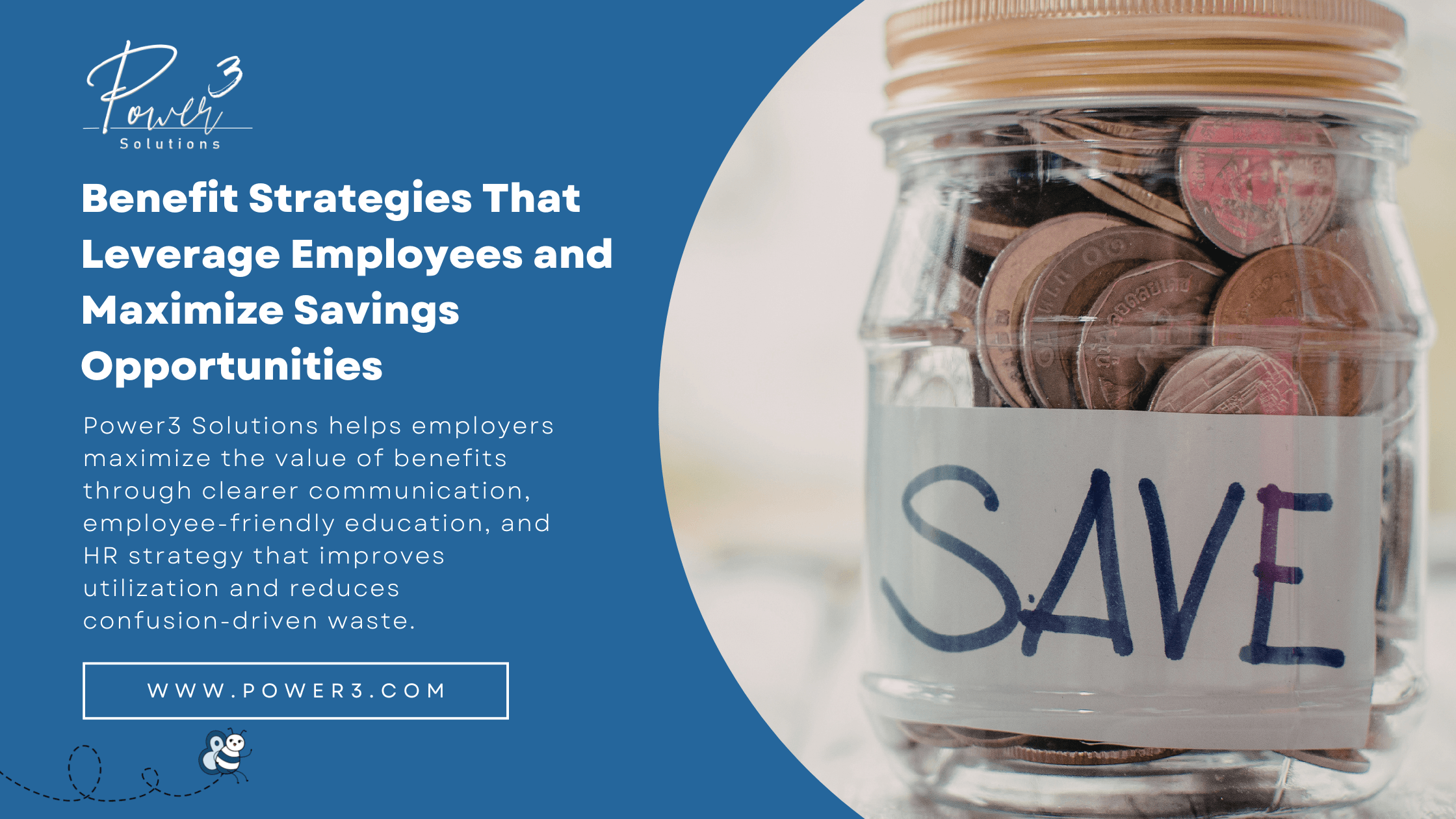
Power3 Solutions helps employers maximize the value of benefits through clearer communication, employee-friendly education, and HR strategy that improves utilization and reduces confusion-driven waste. If you want savings that don’t erode trust, contact Business@power3.com and visit www.power3.com — Your People. Our Mission.